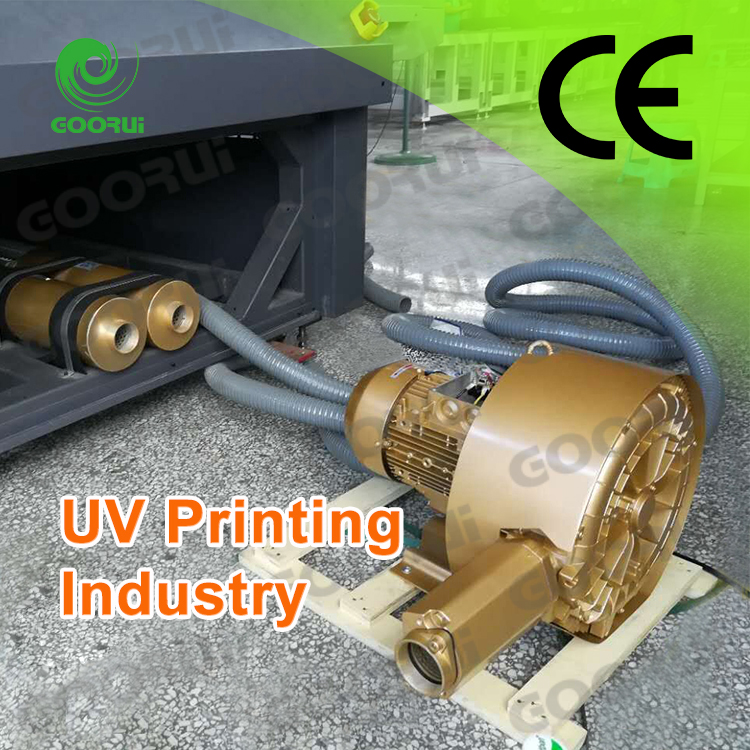
The high-pressure vortex blowers used in the UV flatbed printing industry have the following core characteristics: high negative pressure, low flow rate, continuous and stable vacuum, oil-free and maintenance-free. They are the two main air sources for UV flatbed printers (platform vacuum suction system + nozzle ink path negative pressure system), and some models also have the functions of blowing and waste gas collection.
Vacuum suction platform
Function Principle
The blowers sucks the air from the honeycomb suction platform, creating negative pressure, which firmly holds the sheet material and ensures that the substrate remains stationary throughout the printing process.
Addressing pain points
· Thin acrylic, PVC, soft film, thin plates warping and shifting, resulting in ghosting and inaccurate color matching;
· During high-speed printing and bidirectional movement, the materials slightly bounce;
· Small-sized workpieces cannot be positioned, and the manual edge pressing efficiency is low.
Applicable substrates
Acrylic, glass, wood board, aluminum-plastic board, ceramic tile, cardboard, leather, thin plastic sheet, etc. – rigid / semi-rigid sheets.
Configuration plan
· Small UV (6090/1313): 0.75kW / 1.1kW single-stage blowers.
· Medium-sized industrial machine (1613/2513): 1.5kW – 2.2kW, some large factories adopt dual-fan zone adsorption.
· Large-format 3020/3220 models: 3kW – 4kW dual-stage high-pressure blowers.
Advanced solution
Combine with frequency converter speed control. Increase air volume for thick plates and reduce suction force for thin plates to prevent thin plates from being deformed by suction, achieving energy savings and noise reduction.
Spray head ink path negative pressure system
Maintain a stable negative pressure (typically -3.2 to -4.2 kPa) to keep the liquid level of the balance nozzle constant:
Too low negative pressure: ink flows freely, the nozzle drips ink, and there are white spots on the screen;
Too high negative pressure: ink cannot be sucked in, resulting in ink interruption and streaking.
Automatic nozzle cleaning (positive pressure output)
The outlet end of the fan is connected to a dust removal blade. The printing gap is used to blow away dust and ink mist from the nozzle surface, reducing nozzle blockage.
UV exhaust / ink mist collection
Combined with a suction hood with negative pressure, the volatile ink mist generated during UV curing is collected, improving the working environment of the workshop.
Surface dust removal of the finished product
Before printing, the air knife blows away the dust from the sheet material to prevent ink spots and pinholes from occurring.
Selection guidelines:
1. Prefer aluminum casings and fully enclosed motors, which are durable in environments with workshop dust and ink fumes;
2. An intake filter must be installed to prevent dust and ink vapor from entering the pump body and causing wear;
3. Do not blindly pursue high power: excessive suction force will cause thin plates to deform;
4. For long-term continuous production, it is recommended to use a frequency converter. Adjust the negative pressure as needed to reduce noise and temperature rise.
Common faults, phenomena and causes
1. Insufficient suction force, board movement
Checklist: Air leakage in the pipeline, clogged filter cotton, dust accumulation and wear on the fan impeller, aging of the platform sealing strip.
2. High noise and vibration from the blower
Checklist: Lack of shock-absorbing foot pads, loose base fixation, excessive air intake blockage, imbalance of the fan impeller.
3. Frequent overheating protection of the blower
Checklist: Long-term lack of filter net cleaning, high environmental temperature, long-term full load operation, too small pipe diameter causing pressure build-up in the pipeline.
4. Unstable suction force, fluctuating and unstable
Checklist: Air leakage in the air pipe, blockage of the honeycomb holes on the platform, aging of the fan with increased internal clearance.
Daily Maintenance Tips
1. Clean the intake filter weekly (this is of utmost importance! The UV environment causes the ink mist to easily clog the filter element);
2. Install rubber shock absorbers at the bottom of the fan to reduce vibration transmission to the printing platform and prevent accuracy degradation;
3. Do not seal the exhaust port (pressurization will quickly burn out the blower);
4. Avoid allowing the UV ink mist to directly enter the fan interior;
5. If the machine is shut down for more than 3 days, clean the accumulated water and residual ink mist in the pipelines.
If your business depends on quality performance from air technology equipment, then come and talk to GOORUI to find out more about our air technology services and solutions. Please contact us for the technical datasheet/drawings and to discuss suitability for your application.
Discover why numerous industries trust GOORUI for reliable air solutions by visiting https://www.goorui.com/ or Email us at: service@goorui.com