Biofloc technology has transformed modern aquaculture by making it possible to raise fish and shrimp in relatively small areas while maintaining water quality through continuous aeration, circulation, and microbial activity. Among the most important decisions in designing a biofloc system is choosing the right aeration equipment.
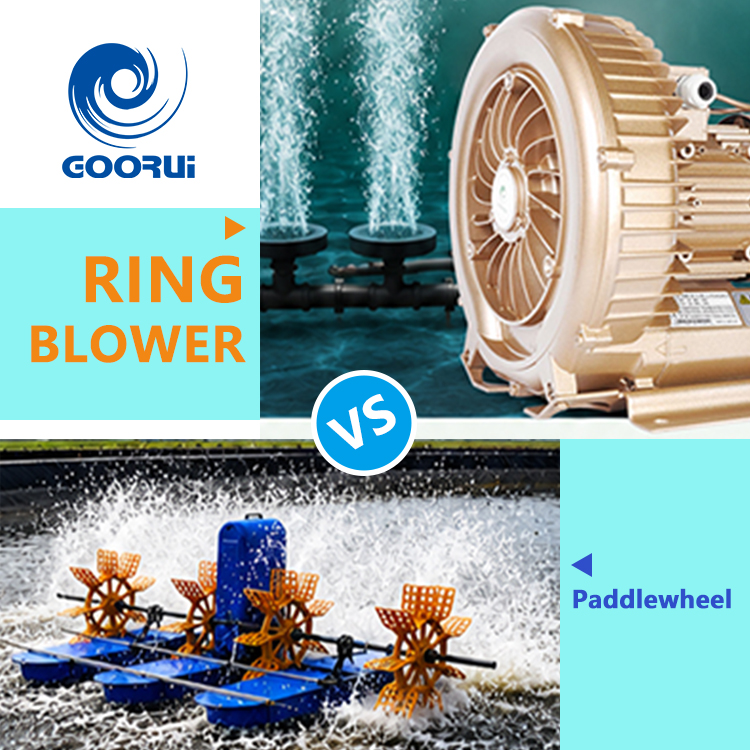
A common question among fish farmers is: Is a ring blower better than a paddlewheel for biofloc?
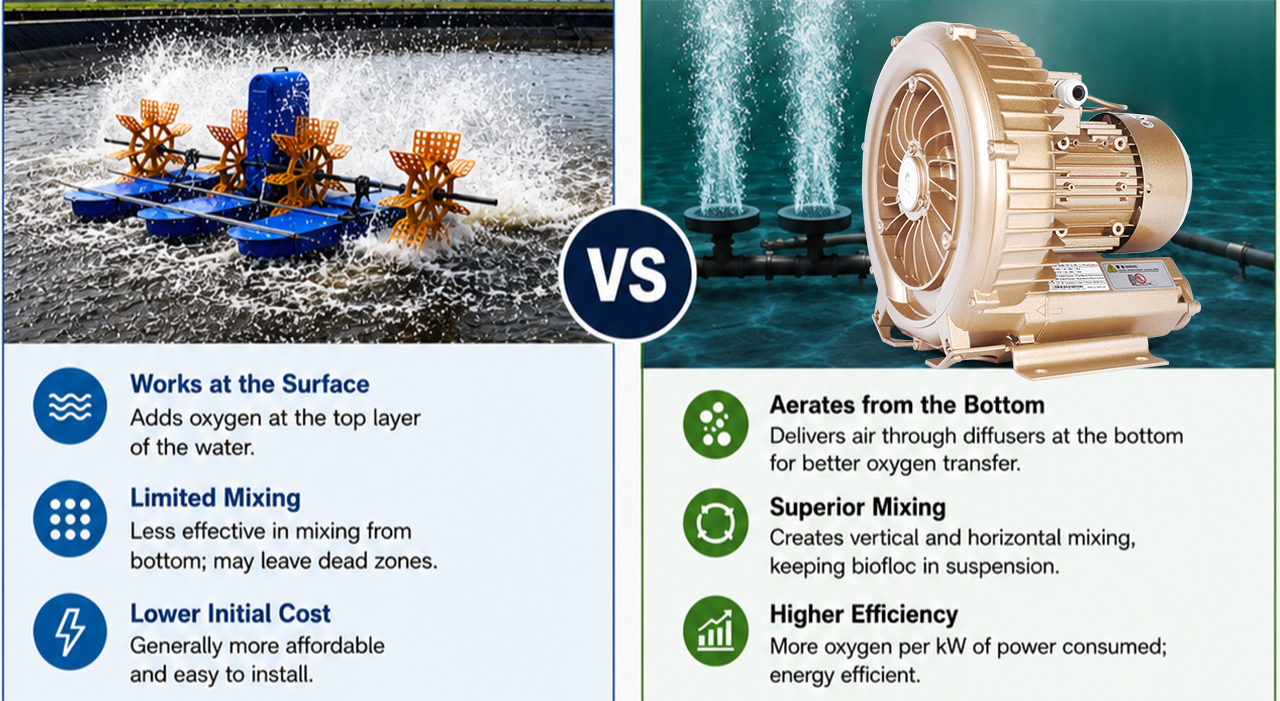
For many biofloc tanks, lined ponds, RAS-style systems, and deeper culture systems, a regenerative ring blower connected to bottom diffusers can be an excellent aeration solution. It supplies continuous air to the water column, supports dissolved oxygen levels, and helps maintain circulation from the bottom upward.
However, the right aeration system ultimately depends on pond size, depth, stocking density, species, water conditions, and the farm’s operating requirements. Paddlewheels can still be highly effective, particularly in large, shallow earthen ponds.
Let’s understand the differences and why ring blowers are widely considered for biofloc applications.
Why aeration is critical in biofloc?
Aeration is not simply about adding oxygen to the water. In a biofloc system, continuous aeration performs several important functions simultaneously. Biofloc relies on microorganisms that consume organic matter and help convert toxic nitrogen compounds into less harmful forms. These microorganisms require oxygen to remain active. At the same time, fish and shrimp continuously consume dissolved oxygen. As stocking density increases, oxygen demand also increases.
Without sufficient aeration, several problems can occur:
· Dissolved oxygen levels can fall rapidly.
· Beneficial microbial activity can be reduced.
· Biofloc particles may settle at the bottom.
· Toxic compounds can accumulate.
· Fish and shrimp may experience stress.
· Feed conversion and growth can be affected.
· Mortality risk can increase in severe conditions.
Therefore, a biofloc aeration system should provide continuous, reliable, and properly distributed aeration. This is where a ring blower can offer significant advantages.
What is a Ring Blower?
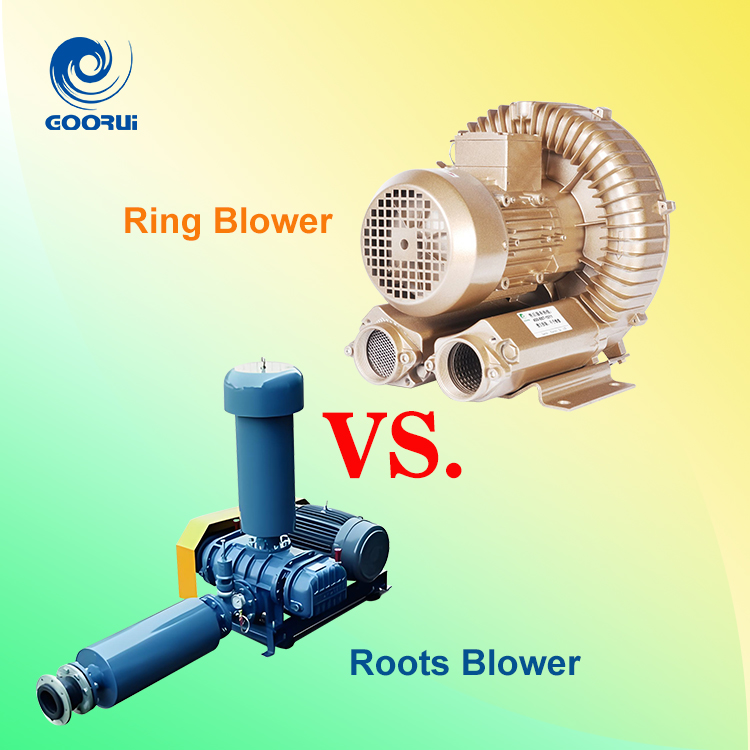
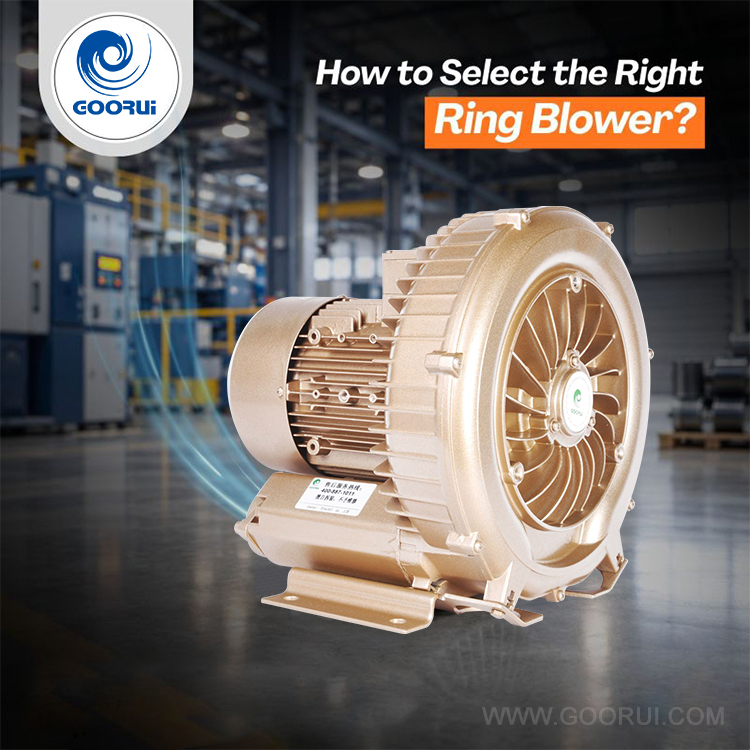
A ring blower, also known as a regenerative blower, side-channel blower, or vortex blower, is an air-moving machine designed to provide continuous airflow at relatively high pressure.
Unlike a conventional centrifugal fan that is primarily designed for moving large volumes of air at comparatively lower pressure, a ring blower can generate the pressure required to push air through:
· Air pipes
· Air hoses
· Diffusers
· Air stones
· Fine-bubble aeration systems
· Bottom aeration networks
In a biofloc application, the ring blower is generally installed outside the tank or pond. Air is distributed through a piping network and delivered to submerged diffusers. The diffuser then breaks the air into bubbles, increasing contact between air and water.
This creates a continuous aeration cycle:
Ring Blower → Air Pipeline → Diffuser → Fine Bubbles → Oxygen Transfer → Water Circulation